How environmentally friendly is uv led curing? The answer depends on more than the lamp. A production line may use less electricity and generate less unwanted heat after switching from conventional mercury-based UV systems. UV LEDs also contain no mercury. But these benefits do not automatically make every cured product sustainable.
UV-curing chemist Dr. Charles Decker is widely recognized for his work in the field. The following is a paraphrase, not a verbatim quotation: his research points to a practical principle—curing performance and environmental impact depend on the complete formulation and process, not the light source alone. That distinction matters. A fast LED system can reduce energy use, yet a poorly matched ink may need extra passes or produce more waste. Small details count: wavelength, irradiance, conveyor speed, substrate, and the electricity supplying the factory.
There are trade-offs. LED equipment has a manufacturing footprint, and its real-world savings vary with operating hours, maintenance, and local power generation. Some coatings also require reformulation before they cure reliably under LED wavelengths. That takes testing. And sometimes, the expected savings are smaller than hoped.
This introduction examines how environmentally friendly is uv led curing through measurable factors: energy per unit, material compatibility, service life, worker exposure controls, and end-of-life considerations. It avoids treating “mercury-free” as proof of sustainability. The more useful question is specific: does an LED system reduce the total impact of this process, under actual production conditions?
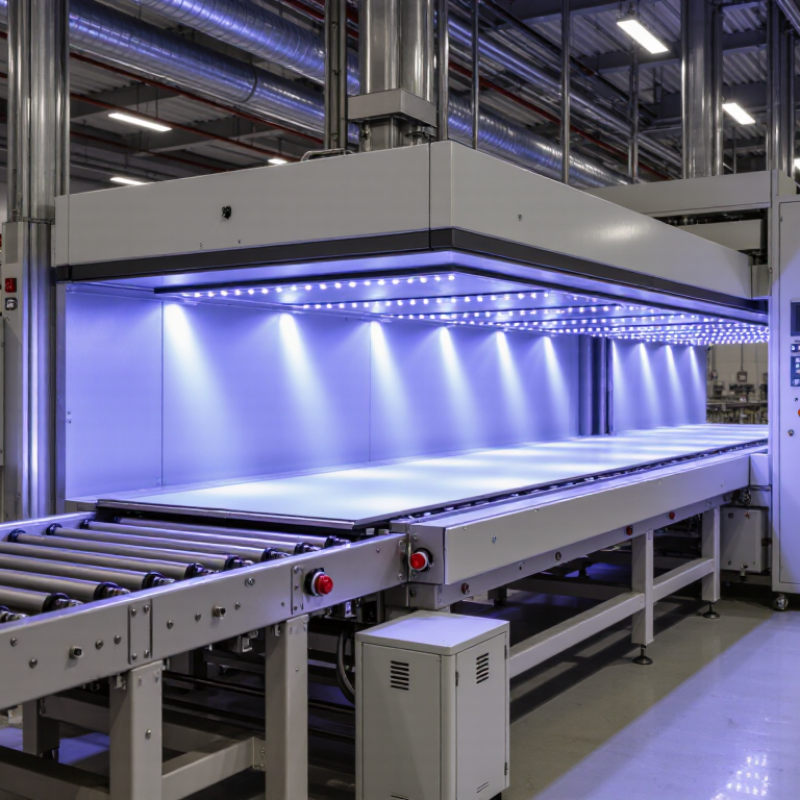
What Is UV LED Curing?
UV LED curing is a way to harden specially formulated inks, coatings, or adhesives with ultraviolet light. A row of LED chips sends selected UV wavelengths onto a wet or tacky layer. The light activates ingredients called photoinitiators, starting reactions that link molecules into a solid polymer network. Depending on the material and equipment, the surface may be ready to handle in seconds. No long oven wait. Unlike drying by evaporation, curing changes the material itself rather than simply removing water or solvent.
The method can reduce heat exposure and may use less electricity than some conventional UV systems. Actual savings depend on lamp design, operating time, and production speed. Those details matter. LED units avoid mercury in the light source and can last a long time, though their electronics still need responsible disposal. Each coating also needs compatible wavelengths; thick or shadowed areas may cure unevenly. A test strip can reveal problems near edges or beneath raised details. A quick surface check is not enough, so operators should follow validated settings and inspect the finished layer. UV LED curing is not automatically environmentally friendly: ingredients, electricity use, and rejected parts all affect its footprint.
How Environmentally Friendly Is UV LED Curing?
UV LED curing uses ultraviolet light from light-emitting diodes to cure inks, coatings, and adhesives. The chart compares two general source characteristics; it does not represent a full lifecycle assessment.
How to read the chart: 1 means “Yes” and 0 means “No.” UV LED sources contain no mercury and typically emit within a narrow wavelength band. Mercury-arc UV lamps contain mercury and emit across a broader spectrum. Overall environmental impact also depends on electricity use, process requirements, equipment lifetime, and end-of-life handling.
How Does UV LED Curing Work?
UV LED curing hardens inks, coatings, and adhesives by triggering a light-sensitive chemical reaction. The LED chips emit ultraviolet light at selected wavelengths, often around 365, 385, or 395 nanometres. A photoinitiator in the material absorbs that light and forms reactive species, which link liquid molecules into a solid polymer network. The result can feel dry within seconds. But speed depends on the formula, layer thickness, wavelength, and light intensity—not just the lamp.
Unlike broad-spectrum mercury lamps, LED systems emit a narrower band of UV light. The wavelength must match the photoinitiator; otherwise, the surface may cure while material beneath remains soft. The U.S. Department of Energy’s 2019 Energy Savings Forecast projected 569 terawatt-hours of annual savings from general LED lighting by 2035. That figure is not specific to UV curing, so it should not be treated as a guaranteed factory saving. Actual results depend on line settings, cooling, and electricity use.
Tips: Check the lamp’s wavelength and irradiance at the working distance. Test a cured sample for tackiness and adhesion, especially over dark or thick layers. Small gaps in testing can matter. UV LED systems can avoid lamp warm-up and reduce heat on the workpiece, but process measurements—not assumptions—show whether a line uses less energy.
How Environmentally Friendly Is UV LED Curing? - How Does UV LED Curing Work?
| Dimension |
What Is True of UV LED Curing? |
Environmental Relevance |
| How curing works |
UV LEDs emit selected wavelengths that activate photoinitiators in a UV-curable ink, coating, or adhesive. This starts a rapid chemical reaction that hardens the material. |
The process can cure material quickly, but its environmental profile also depends on the formulation and how much material is used. |
| Wavelengths |
UV curing systems commonly use LED emissions around 365, 385, or 395 nanometres. Some systems use 405 nanometres, which is near-violet visible light. |
The wavelength must match the photoinitiator and application. A mismatch can lead to incomplete curing and wasted material. |
| Mercury content |
LED light sources do not use mercury to produce light. Traditional mercury-vapour UV lamps contain mercury. |
Replacing a mercury lamp can avoid mercury in the light source, though proper handling and disposal of existing lamps remain important. |
| Energy use |
LEDs can be switched on and off rapidly and do not need the same warm-up period as many conventional UV lamps. Actual electricity use depends on the equipment, output settings, and production process. |
Energy savings are possible, especially where equipment can be switched off between jobs, but they are not guaranteed for every installation. |
| Heat and cooling |
UV LED systems generally direct less infrared radiation toward the work surface than conventional mercury-vapour systems. LED equipment can still generate heat and may require cooling. |
Lower heat exposure can help with heat-sensitive substrates. The energy used by cooling should be included when assessing the whole system. |
| Ozone |
Common UV-A curing LEDs, such as those operating around 365–395 nanometres, do not normally produce ozone from oxygen in air. Ozone generation is associated with shorter-wavelength UV. |
Ozone concerns are generally lower with common UV-A LED curing systems, but ventilation may still be needed for process emissions. |
| Process emissions |
LEDs do not make a coating or ink emission-free. Unreacted ingredients and other process emissions depend on the specific formulation and whether it cures fully. |
Choose materials suited to the application, follow supplier safety guidance, and provide appropriate ventilation and exposure controls. |
| Service life and waste |
LED light sources can have long service lives, but actual life depends on operating conditions, thermal management, and the equipment design. The complete unit may contain electronic components. |
Longer replacement intervals may reduce lamp waste. LED units should be managed through appropriate electronic-waste or equipment-recycling routes. |
| Overall, UV LED curing can reduce some environmental burdens, particularly mercury use and potentially energy consumption. The outcome depends on the complete system, the curing formulation, operating practices, and end-of-life handling. |
What Environmental Benefits Can It Provide?
UV LED curing can reduce environmental impacts, especially where solvent-based coatings are replaced with suitable 100%-solids formulations. The U.S. Environmental Protection Agency’s guidance on UV/EB curing explains that these formulations contain little or no solvent carrier, so less solvent evaporates during curing. That can mean lower volatile organic compound (VOC) emissions at the production line. Less solvent also means fewer fumes to capture and manage. The benefit depends on the formulation; “UV-cured” alone does not guarantee low emissions.
There are practical resource savings, too. UV LEDs switch on instantly and can be switched off between production runs, avoiding the warm-up period associated with some conventional UV systems. RadTech’s industry guidance identifies reduced energy use and longer lamp life as potential advantages of UV LED curing, though actual savings vary with line speed, lamp output, and maintenance. One caveat: curing units still use electricity, and poorly matched settings can create waste or defects.
Tips: Check the coating’s safety data sheet and measure electricity use per finished unit before and after installation. Track rejects, too. A lower-emission process is only a real improvement when the cured product meets quality requirements and avoids unnecessary rework.
What Environmental Impacts and Limitations Remain?
UV LED curing avoids mercury lamps and can reduce heat around the production line, but “mercury-free” does not mean impact-free. RadTech’s UV/EB industry guidance reports energy savings of up to 50–80% compared with thermal drying in suitable applications. Treat that as a potential range, not a guaranteed factory result. Line speed, lamp distance, ink chemistry, and cooling demand all affect consumption. Small details matter: a conveyor running beneath an empty curing zone still uses electricity.
Electricity has an environmental cost. The International Energy Agency’s Global Energy Review 2024 estimates energy-related carbon dioxide emissions reached 37.4 billion tonnes in 2023. That global figure is not a UV-curing footprint, but it shows why a facility’s power source matters. Cleaner electricity can improve the process’s overall profile; a carbon-intensive grid can shrink the benefit.
There are trade-offs. LED modules contain electronic components that need responsible end-of-life handling, and replacing lamps less often does not remove this waste stream. Inks must also cure fully: poor settings can leave uncured material, while some substrates or formulations may not suit LED wavelengths. Not every line can switch without testing. Measure energy per finished unit, include cooling and idle time, and check curing quality before claiming environmental gains.
Where Is UV LED Curing Used?
UV LED curing is used wherever a liquid coating, ink, or adhesive needs to harden quickly under ultraviolet light. In printing shops, it dries inks on labels, cartons, and promotional graphics. A freshly printed sheet can move along without waiting hours. That helps reduce smudging and production delays.
It also appears in coatings for furniture, flooring, and plastic parts. Manufacturers use it to form protective finishes on surfaces such as cabinet panels or phone housings. In electronics assembly, UV-curable adhesives can secure small components or seal selected joints. Some dental materials are cured this way, too. The process needs a clear path to the material: opaque surfaces, deep recesses, and shaded joints may not receive enough light. That detail can be easy to overlook.
The environmental benefits depend on the job. LED systems can use less energy and produce less heat than some conventional curing setups, but results vary with equipment and operating conditions. They may also reduce solvent use in certain coatings. Still, curing does not make a product sustainable by itself. I would check the full process, including material choice, electricity use, ventilation, and leftover waste. Sometimes the practical answer is less tidy than the sales pitch.
Conclusion
UV LED curing uses light-emitting diodes to harden inks, coatings, adhesives, and other materials through a light-triggered chemical reaction. Unlike conventional curing methods that may rely on heat or broad-spectrum lamps, UV LED systems emit selected wavelengths that activate specially formulated materials. The process can be fast and precise, making it useful in printing, manufacturing, electronics, and other applications where controlled curing is important.
When considering how environmentally friendly is uv led curing, its potential advantages include lower energy use, reduced heat generation, longer lamp life, and less reliance on solvents in some processes. These features may help reduce emissions and material waste. However, the technology is not impact-free: producing LEDs and specialized curing materials requires resources, and some formulations may contain substances that need careful handling. Performance also depends on compatibility between the light source and the material, while equipment and material disposal remain relevant environmental considerations. Overall, UV LED curing can support more efficient production, but its benefits depend on the full process and responsible material choices.

 LumiCure Light