Top 10 Things to Consider Before Buying a UV Curing System

Time:2026-10-09 Author:Amelia
0%

Choosing a UV curing system is more than comparing lamp power and purchase prices. The right equipment must match your materials, production speed, curing distance, and workspace conditions. A coating may look dry under bright light yet remain undercured beneath the surface. That mistake can lead to weak adhesion, surface defects, or costly rework.

So, what should you consider before buying a uv curing system? Begin with the curing chemistry and required wavelength. Different UV adhesives, inks, and coatings respond to different spectral ranges. Irradiance, exposure time, and energy dose also affect the final result. Ask suppliers for measured performance data, not only attractive brochure claims. Request testing with your actual substrate, application thickness, and production settings.

Safety and reliability deserve equal attention. Check shielding, interlocks, heat management, ventilation, and operator access. Confirm whether the system supports stable output during long production runs. Maintenance requirements matter too. Lamp replacement, LED module life, calibration, and spare-part availability can influence operating costs more than the initial quote. A reputable manufacturer should provide technical documentation, training, and responsive after-sales support.

Budget pressure can make a cheaper system seem sensible. Sometimes it is. However, a low purchase price may hide poor cooling or limited control options. That lesson is easy to learn late. Consider throughput, energy consumption, downtime, and future expansion before deciding. No system is perfect. Even experienced buyers can overlook compatibility details. A small trial, careful measurement, and independent technical review can prevent an expensive assumption from becoming permanent.
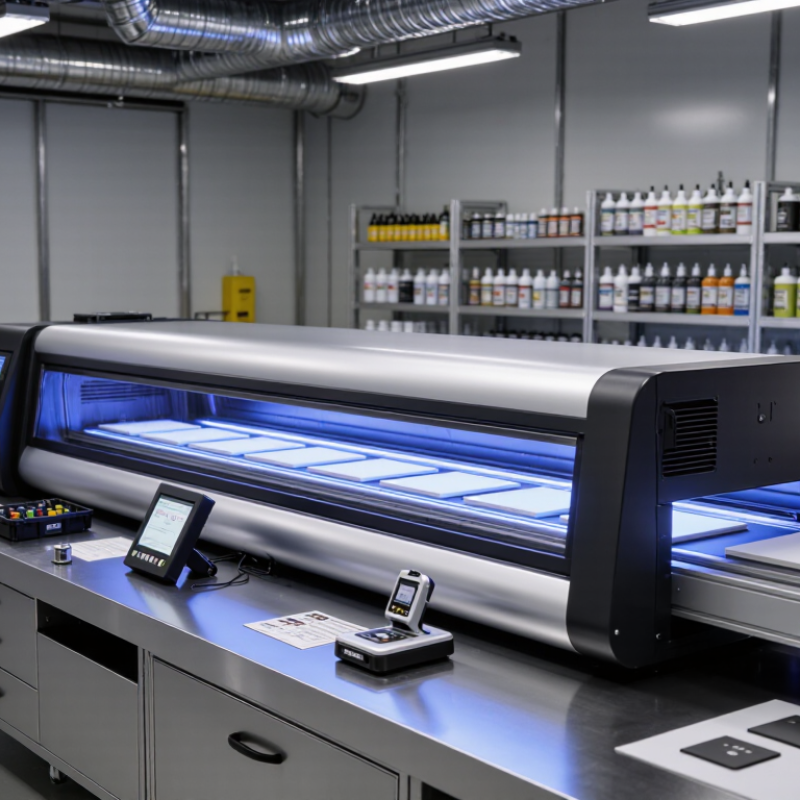
Top 10 Things to Consider Before Buying a UV Curing System

Define the UV Curing Process and Its Intended Application

Before buying a UV curing system, define the process and its intended application precisely.

UV curing uses ultraviolet energy to initiate polymerization in inks, coatings, or adhesives. The key variables are wavelength, irradiance, dose, exposure time, line speed, and substrate distance. A lamp may show high power, yet deliver an unsuitable dose at the work surface. That difference matters.

The application sets the equipment requirements. Screen ink on glass may need uniform surface exposure. A thick adhesive layer may require deeper penetration and longer exposure. Heat-sensitive plastics need controlled thermal output.

According to a 2023 MarketsandMarkets report, the global UV curing market was estimated at approximately USD 6.2 billion. This growth reflects wider use in electronics, packaging, automotive components, and industrial assembly. However, market growth does not guarantee process compatibility. Test results do.

Tips:

Measure irradiance and dose at the actual curing position. Do not rely only on the equipment specification sheet. Record substrate color, coating thickness, conveyor speed, and ambient temperature. Then verify adhesion, hardness, tack, and chemical resistance using relevant ASTM or ISO methods.

A 2022 RadTech industry report emphasized process control and energy efficiency as major UV technology priorities. Still, one test can mislead. Cure the weakest-looking area, not only the perfect sample.

Match UV Wavelength and Intensity to the Curing Material

Before buying a UV curing system, match its wavelength to the material’s photoinitiator. A lamp’s wavelength label is not enough. UV-curable resins respond to specific absorption ranges. ISO 21348 defines ultraviolet radiation as 100–400 nm. Commercial curing commonly uses 365, 385, 395, or 405 nm. Ask for the material’s absorption curve and minimum curing dose. RadTech’s 2024 UV+EB Technology Report identifies LED conversion and process control as important industry priorities. Higher output is not automatically better.

Intensity and dose are different measurements. Dose equals irradiance multiplied by exposure time. For example, 800 mW/cm² applied for 2.5 seconds delivers approximately 2 J/cm². However, distance, reflector design, surface angle, heat, and oxygen inhibition can change the result. A cured surface may still hide a soft layer underneath. That mistake happens often.

Use a calibrated radiometer near the actual work surface. IEC 62471 also supports photobiological risk assessment for optical radiation. Check readings across the conveyor, not only at its center. The 2023 Global UV LED Market report from Yole Group highlights efficiency and thermal management as continuing development concerns. These factors matter during long production runs. In practice, a slightly lower but stable intensity can outperform a powerful system with uneven coverage. Test the real material, thickness, color, and speed. Lab results can mislead.

Top 10 Things to Consider Before Buying a UV Curing System - Match UV Wavelength and Intensity to the Curing Material

No. Consideration Relevant Data or Typical Range Why It Matters What to Verify Before Purchase
1 Curing Wavelength Common UV ranges include UVA at 315–400 nm, UVB at 280–315 nm, and UVC at 100–280 nm. UV LED curing systems commonly operate near 365, 385, 395, or 405 nm. Photoinitiators absorb specific wavelengths. A strong lamp can still produce poor curing if its emission does not overlap the material’s absorption spectrum. Obtain the photoinitiator absorption range from the material supplier and compare it with the system’s measured spectral output, not only its nominal wavelength.
2 Irradiance or Light Intensity Irradiance is measured in W/cm² or mW/cm². Laboratory and production systems may range from below 0.1 W/cm² to several W/cm², depending on the process. Higher irradiance can shorten exposure time, but excessive intensity may increase surface heating, shrinkage, internal stress, or oxygen-inhibition effects. Confirm irradiance at the actual working distance, across the usable area, and at the required wavelength using a calibrated radiometer.
3 Required UV Dose Dose is expressed in J/cm² and is calculated as: dose = irradiance × exposure time. For example, 1 W/cm² applied for 2 seconds delivers approximately 2 J/cm². Many formulations require a minimum energy dose for adequate conversion, adhesion, hardness, and chemical resistance. Request the supplier’s minimum and recommended dose, then validate it on the real part using hardness, adhesion, tack, and chemical-resistance tests.
4 Material Thickness and Optical Depth Clear coatings and adhesives may cure through millimeter-scale layers, while pigmented, filled, or opaque materials can have much lower UV penetration. Pigments, fillers, bubbles, and high viscosity can scatter or absorb UV energy, causing the surface to cure while the lower layer remains under-cured. Test the maximum production thickness and inspect both surface and bulk properties. Consider dual-cure materials when UV cannot reach hidden areas.
5 Exposure Time and Throughput Exposure time may range from fractions of a second for spot bonding to several seconds or more for coatings, inks, and thick sections. Conveyor speed must be matched to exposure length. The required dose depends on both irradiance and time. Increasing line speed without increasing usable irradiance can reduce cure quality. Calculate the available exposure time at the intended line speed and confirm that the system maintains the required dose at minimum and maximum speeds.
6 Spectral Uniformity Irradiance should be consistent across the curing area. A practical acceptance limit must be defined for the application; many processes target variation of approximately ±10% or better. Non-uniform light can create inconsistent tack, gloss, adhesion, hardness, or conversion from one location to another. Ask for irradiance maps at the production distance and verify corners, edges, center points, and areas affected by part geometry.
7 Temperature Control UV LED sources generally produce less infrared radiation than many arc lamps, but the LEDs and workpiece still require thermal management. Temperature limits are formulation- and substrate-dependent. Excess heat can warp plastics, damage electronics, accelerate yellowing, change viscosity, or alter curing kinetics. Measure the actual part temperature during the full cycle and check cooling capacity, airflow, heat sinks, and allowable substrate temperature.
8 Oxygen Inhibition and Atmosphere Oxygen can inhibit free-radical curing at the exposed surface, particularly in thin films and coatings. Nitrogen inerting can reduce surface tack when the formulation and process permit it. A material may reach adequate bulk conversion while remaining sticky or soft at the surface because of oxygen inhibition. Determine whether the process needs inert gas, a higher dose, a different photoinitiator package, or a formulation designed for air curing.
9 Monitoring and Calibration Irradiance and dose can change with LED aging, lamp aging, contamination, optical degradation, cooling problems, or changes in working distance. Without process monitoring, gradual loss of UV output may produce defective parts before the problem is detected. Check for an integrated radiometer, dose alarms, data logging, interlocks, calibration records, and a defined verification interval.
10 Safety, Shielding, and Application Fit UV exposure can injure eyes and skin. UVC and shorter-wavelength UV require especially careful shielding. The system should also fit the part size, geometry, working distance, and production environment. Effective curing is not enough if operators are exposed to hazardous radiation or if fixtures create blocked and shadowed regions. Confirm full enclosure or shielding, door interlocks, emergency stops, warning indicators, ventilation requirements, access controls, and compatibility with the production fixture.

Note: Wavelength, irradiance, dose, exposure time, and temperature requirements must be validated with the specific UV-curable formulation, part geometry, and production process.

Evaluate System Size, Speed, and Production Capacity

System size should follow the product, not the showroom footprint. Measure the widest part, tallest feature, and clearance needed for handling. A narrow conveyor may suit labels but restrict wider panels or irregular parts. Check the curing chamber’s usable width, height, and access for cleaning. These details affect installation, operator safety, and future production changes. Small systems can become expensive bottlenecks.

Speed must be tested with the actual coating, substrate, and ink. Ask for verified dose and irradiance data at the working distance. Nominal lamp power alone cannot prove complete curing. Check surface temperature too, especially for heat-sensitive materials. Production capacity requires more than a fast conveyor. Calculate parts per hour, loading time, curing time, inspection, and planned downtime. Then compare that figure with peak orders, not today’s average.

Leave room for rejects and maintenance. I once accepted an optimistic throughput estimate because the test used uniform flat samples. Real parts had shadows and thicker coating, so the line needed slower travel. That mistake changed our evaluation. Request trials using representative materials and the highest expected coating thickness. Record cure results, surface temperature, energy use, and repeatability across several runs. A system that meets speed only under ideal conditions may disappoint on the factory floor. Include those test results in the purchase specification.

Check Equipment Safety, Controls, Maintenance, and Service

Before buying a UV curing system, examine safety controls as carefully as curing speed. UV exposure can injure eyes and skin without immediate pain. ICNIRP’s ultraviolet guidance sets an effective exposure limit of 30 J/m² over an eight-hour period for certain UV wavelengths. Ask for measured emissions, shielding details, interlocks, and emergency-stop testing. A clear viewing window is useful, but it must block the system’s working wavelength.

Controls should show lamp intensity, temperature, conveyor speed, operating hours, and fault history. The U.S. Department of Energy’s 2023 SSL R&D Opportunities report identifies monitoring and thermal management as important factors in efficient solid-state lighting systems. Those principles also matter in UV curing.

A simple display is not enough. Operators need readable alarms and controlled access during maintenance. I would test the interface with gloves on. It may look obvious, yet real production floors are rarely perfect.

Maintenance planning often decides whether equipment remains productive. Request lamp or LED module life data, filter-replacement intervals, calibration procedures, and recommended spare parts. RadTech’s industry reports continue to highlight process control and technical support as practical concerns for UV and electron-beam applications.

Service response should include remote diagnostics, on-site training, and documented repair times. Check whether technicians can verify irradiance after repairs.

We once treated cleaning as a minor task; dust buildup later changed curing results. That mistake is avoidable. Service quality matters.

Compare Operating Costs, Compatibility, and Future Expansion

Before buying a UV curing system, calculate operating costs beyond electricity. RadTech’s UV+EB Technology Roadmap reports that UV LED curing can reduce energy use substantially versus conventional arc lamps. Actual savings depend on duty cycle, cooling, and line speed. Replacement intervals matter too. A lamp may consume more power, require warm-up time, and produce additional heat. Ask suppliers for irradiance data at the working distance, not only rated wattage. Small details become expensive.

Compatibility deserves a practical test. Confirm the required wavelength, such as 365, 385, 395, or 405 nanometers. The coating’s photoinitiator must respond effectively at that wavelength. Check substrate temperature, adhesive depth, surface geometry, and cure shadowing. A 2024 Smithers report on UV curing highlights growing demand for LED-compatible formulations, but conversion is not always simple. Existing materials may cure slowly or remain tacky. We learned this the hard way in trials. A clean-looking spreadsheet can still hide poor adhesion.

Plan expansion before installation. Grand View Research forecasts strong growth in the UV curing system market through 2030, reflecting wider adoption across industrial production. Choose modular heads, accessible controls, and spare capacity for future stations. Verify whether the system can connect with conveyors, sensors, shielding, and production software. Include maintenance access in the layout. It sounds obvious. It is often missed. A cheaper unit may fit today’s line but force costly redesign later. Request sample testing, logged measurements, and a written compatibility record before approval.

FAQS

How do I choose the correct UV wavelength?

Match the wavelength to the material’s photoinitiator absorption range. Common options include 365, 385, 395, and 405 nanometers. Ask for the absorption curve and minimum curing dose.

Is higher UV intensity always better?

No. Excessive intensity can create heat, uneven curing, or surface defects. Stable coverage often beats a stronger but inconsistent output.

What is the difference between intensity and dose?

Intensity measures UV power at a surface. Dose equals irradiance multiplied by exposure time. For example, 800 mW/cm² for 2.5 seconds delivers about 2 J/cm².

Where should UV intensity be measured?

Use a calibrated radiometer near the real work surface. Measure across the conveyor, including both edges. The center reading can look perfect while the edges under-cure.

Can a cured surface hide problems underneath?

Yes. The top layer may feel hard while deeper material remains soft. Thickness, color, shadows, distance, heat, and oxygen can affect curing.

What should I test before approving a UV curing system?

Test the actual material, thickness, color, surface shape, and production speed. Check adhesion and tackiness afterward. A clean spreadsheet may still hide poor results.

How should I compare operating costs?

Include electricity, cooling, warm-up time, replacement parts, and maintenance access. Request irradiance at the working distance, not only rated wattage. Small differences become expensive over long runs.

What should I consider for future production expansion?

Choose modular curing heads, accessible controls, and spare capacity. Confirm connections with conveyors, sensors, shielding, and production software. We sometimes plan for today and regret tomorrow.

Conclusion

Before investing in a UV curing system, it is important to understand the curing process and define its intended application, including the material, coating, adhesive, or component being treated. The question “what should you consider before buying a uv curing system” begins with matching the system’s UV wavelength and intensity to the material’s curing requirements. Proper alignment helps achieve consistent results, avoid under-curing or overheating, and support reliable production quality.

You should also evaluate the equipment’s size, curing speed, and production capacity to ensure it fits current workflow demands. Safety features, control options, maintenance requirements, and service support are equally important for stable long-term operation. Finally, compare operating costs, energy use, compatibility with existing equipment, and opportunities for future expansion. A well-planned choice should balance performance, efficiency, ease of use, and total ownership cost rather than focusing only on the initial purchase price.

Amelia

Amelia

Amelia is a seasoned marketing professional with a wealth of expertise in our company’s core offerings. With an unwavering passion for driving growth and innovation, she plays a pivotal role in shaping our marketing strategies and enhancing brand visibility. A key aspect of her responsibilities......